


TL;DR: A weak marketing message is a clarity problem, not a copywriting problem.
The message you put in front of buyers is only as strong as the thinking that sits behind it – specifically, how well you’ve defined who you’re speaking to, what they’re carrying, and the exact words they use about it.
- A vague audience definition produces a vague message, regardless of how skilled the writer is.
- Buyers respond to their own language reflected at them, not polished seller language.
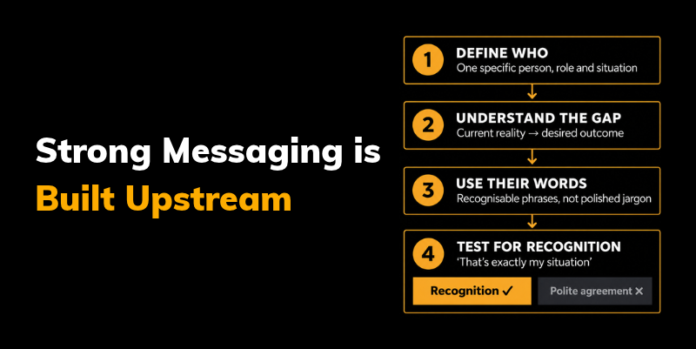
- The sequence matters: audience definition comes first, then buyer understanding, then language.
- Testing your message with one real person who fits your audience is faster and more honest than any internal review.
- Doing the upstream thinking is slower than briefing a rewrite – and the only thing that makes rewrites stick.
A founder I spoke to recently had rewritten his homepage four times in a year. Different copywriters, different hooks, different headlines. Each version looked sharper than the last… and each one converted at roughly the same disappointing rate.
He assumed the words were the problem. The words weren’t the problem. He just hadn’t finished the thinking underneath them yet, and no amount of skilled copywriting fixes that.
What Does a Strong Message Actually Depend On?
A message that lands is the visible end of an ordered chain. Each link depends on the one before it, and the sequence matters more than the effort you pour into any single link.
The chain runs like this:
- Audience definition. A specific, written-down picture of who this is for. Written down is the operative phrase… a vague picture living in your head can’t guide anything.
- Buyer understanding. A genuine read of where that person is now, what problem they carry, and what result they actually want.
- Language precision. The message expressed in the words your buyer already uses about their own situation.
Skip a link and everything after it wobbles. You can hire brilliant wordsmiths and the copy still slides off the reader, because it describes a person nobody defined and a problem nobody examined properly.
The weak headline is what you can see. The undefined audience is what you can’t. The symptom is always at the surface.
Key Point: Message strength sits downstream of structural clarity. Fix the thinking that feeds the message, and the words start writing themselves.
Why Does Polished Copy Still Fail to Land?
A lot of the copy that fails is well written. The sentences flow, the structure is tidy, the call to action is clear. The problem sits in whose language it speaks.
It speaks in the seller’s polished terms.
Your buyer describes their situation in specific, slightly messy, deeply recognisable words. They say things like “I can’t take a week off without everything stalling” or “I’m the only one who can answer the hard questions.” When your message uses those exact words, something shifts. The reader feels seen rather than sold to.
💡 A useful test: read your message to one real person who fits your audience. Strong recognition (“that’s exactly my situation”) is the signal you want. Polite agreement is a fail, even when it feels pleasant in the moment.
Once you accept that the job of a message is to reach people who already recognise the problem, the pressure to convince disappears… and the pressure to understand takes its place. That’s a far more productive place to work from.
Key Point: Buyers respond to recognition, not persuasion. The moment they read their own situation back at them, the message does its job.
Where Should You Intervene First?
You wouldn’t repaint a wall carrying a structural crack. You’d shore up what sits behind it first, because the paint only ever looks as good as the surface it’s applied to. Your message works the same way.
So before you touch the words again, do three things.
First, write the audience down. One person, described specifically. Their business stage, their role, the weight they’re carrying. If you can’t write it in five sentences, you’ve found your real problem, and it was never the headline.
Second, write out where this person is now and where they’re trying to get to. Both ends matter. A message built on only one end reads as generic, because it is.
Third, collect their language. Pull the exact phrases from sales calls, emails, and conversations. Treat those words as your raw material. Resist the urge to tidy them into something more professional… the roughness is what makes them recognisable.
This approach has a cost. It’s slower than briefing another rewrite. It asks you to sit with questions you may have been avoiding, particularly the question of who your business is really for. That discomfort is the work, and it’s the part that makes every rewrite after it actually stick.
Key Point: The upstream thinking is slower and more uncomfortable than a quick rewrite. It’s also the only thing that makes the next version perform differently.
What Does This Mean for You?
The founder with four failed homepages needed a defined audience, a genuine read of that audience’s problem, and their own words reflected at them. Once those existed, the fifth version took a fraction of the time and finally converted. Empathy first, then strategy, then expression.
Key Point: The sequence is non-negotiable. Empathy before strategy, strategy before expression. Get the order wrong and even the best writing lands flat.
Key Takeaways
- A weak message is a clarity problem upstream, not a copywriting problem at the surface.
- The chain runs in order: audience definition, then buyer understanding, then language precision. Skip a link and everything after it wobbles.
- Your buyer’s words about their own situation are more powerful in your message than your polished professional language.
- Test your message with one real person who fits your audience. Strong recognition is the only pass mark.
- Writing the audience down in five sentences is the work most founders have been avoiding.
- Doing this thinking is slower than briefing a rewrite, and the only thing that makes rewrites actually stick.
Frequently Asked Questions
Why does a weak marketing message usually come down to unclear thinking rather than poor writing?
Because writing is the final layer. The words you choose can only be as precise as your understanding of who you’re writing for and what they’re carrying. When the audience is undefined, or the buyer’s problem is assumed rather than examined, the message reflects that vagueness regardless of how skilled the writer is.
How do you define your audience specifically enough for it to guide your message?
Write one person down in five sentences. Their business stage, their role, the specific weight they’re carrying right now. If you can’t do that without reaching for generalities, the audience definition isn’t done yet.
What’s the difference between buyer understanding and audience definition?
Audience definition is who the person is. Buyer understanding is what they’re experiencing right now, what problem they’re carrying, and what result they actually want. You need both. A message built on audience definition alone misses the emotional context that makes a buyer feel seen.
How do you collect buyer language if you don’t have many sales conversations yet?
Use what you have. Emails from potential clients, replies to your content, conversations in communities where your audience asks questions. Pull the exact phrasing people use, even when it’s rough. Especially when it’s rough.
How do you test whether your message is working?
Read it to one real person who fits your audience and watch their reaction. Strong recognition, “that’s exactly my situation,” is the signal you want. Polite agreement is a fail, even when it feels pleasant in the moment.
Why does polished copy often perform worse than less refined language?
Because polished language tends to reflect how the seller thinks about the product, not how the buyer experiences the problem. The more you refine raw buyer language into professional-sounding terms, the less recognisable it becomes to the person you’re trying to reach.
What’s the most common reason founders keep rewriting their homepage without improving conversion?
They’re working on the surface layer. Each new version gets sharper in execution but carries the same undefined audience and unexamined buyer problem underneath. The rewrite produces diminishing returns because the structural issues haven’t been addressed.
How long does the upstream thinking actually take?
Longer than a brief to a copywriter, shorter than another failed launch. For a founder who engages with the questions seriously, a few days of focused work tends to unlock more progress than months of iterative rewrites.