

Owner-operators rightly believe that they are too busy to sit around dreaming.
There are clients to look after. There are invoices to chase, a team to support, a to-do list that never seems to get shorter.
Vision feels like something for later.
Something for big companies with boardrooms and away days.
But if you speak to one, you will find the same things come up.
They are working more hours than they did when they were employed. The business has grown, but the life around it has not.
They are not sure what “enough” looks like, so they keep chasing more. And when a new opportunity lands, they say yes, because nothing tells them to say no.
If any of that sounds like you, keep reading.
Because what is missing is not another tactic. It is not a new tool, a new funnel or a new platform.
It is a business vision. A real one, written down, built around the life you want to live.
By the end of this guide, you will have a clear, step-by-step way to build yours. And I think you will enjoy it more than you expect.
What is a business vision, really?
Search for it, and you will find a wall of corporate examples. Big brands, big statements, big posters in reception.
That is fine, and understandable. Those companies need them.
But that is not where your business vision starts.
Your business vision is a picture of where you are going and why. Yes, it includes the revenue and the clients. It also includes the life you are building around the business.
How you spend your days.
Your time. Your energy.
What success looks like for you, not for the person whose highlights you keep scrolling past at 11 pm.
A business vision is not a sentence for your website. It is a decision about your life. The business is the vehicle. Your life is the destination.
I have said this before, and I will keep saying it.
If your business is not designed to support the life you want, you have not built a business. You have built yourself a job. Often a harder one than the job you left.
Why everything starts with a dream
Think about the last time you got on a plane. Hundreds of people. Tonnes of metal. Thirty-odd thousand feet in the air, and you are reading a magazine.
Before any of that existed, somebody dreamed it. Again and again. Then they sketched it. Then they planned it. And only then did anyone start building it.
Your business is no different. Dream first, then plan, and only then build.
Now, I know how this sounds.
Daydreaming as a growth strategy. It sounds a little weird.
When a coach first told me that the best way to grow a business is to daydream, my first response was “huh?”
Then I saw it work in my own business, and I have watched it work for the business owners I have taken through this exercise for over a decade. I stand by it completely.
Here is the part that costs people. Skipping it.
Going straight to lead generation, systems and the next shiny thing, without ever stopping to ask what it is all for.
It is like adding a second floor to a house before anyone has checked the ground. It might stand for a while. Sooner or later, the cracks show up.
Vision is the ground. Get that right, and everything you build on top of it has somewhere solid to stand.
Before you start: three ground rules
1. Give it proper time. Block out an hour. Put your phone in another room. Find somewhere comfortable. This is not something to squeeze in between calls.
2. Don’t treat it like homework. School trained us to see a question, fill the box and move on to the next one. Unlearn that here. There are no marks. Nobody is grading you. The value is in the thinking, not the speed.
3. Write the real version, not the polished one. Nobody else needs to read this yet. If your answer surprises you, embarrasses you or excites you, that is usually a sign you are getting somewhere.
How to create a vision for your business in 9 steps
These steps come from my Ultimate Business Vision workshop, which I have run with business owners for years. The order matters. Your life comes first, your business second. Take them one at a time.
Step 1: Get comfortable and permit yourself to dream
Sit back. Close your eyes. Get into the most comfortable position you can find. Let your shoulders drop.
This feels strange the first time, and that is fine. You spend all day reacting. Answering messages, fixing problems, putting out fires. For the next few minutes, you are not reacting to anything. You are imagining. That shift alone is worth the hour.
Step 2: Answer the money question
Imagine that at the end of this month, £20,000 lands in your bank account. Now imagine the same amount lands at the end of next month. And the month after that. Every month, for the rest of your life.
The question: If money was no longer the reason you got up in the morning, what would you do with your days?
Sit with it. The first answers tend to be the obvious ones. Rest. Travel. A long lie-in. Let those come. Then keep going, because underneath them is something more interesting. The work you would still choose to do. The people you would still want to help. The thing you would build even if nobody paid you for it.
That is where your vision starts to show itself.
Step 3: Design your life first
Now take what came up and design the life you want. If you could have it exactly how you wanted it, what would it look like?
- Where do you live, and who is around you?
- What does a normal Tuesday look like, from the moment you wake up?
- How many hours are you working, and on what?
- What are you doing with the time that is not work?
Be specific. “More freedom” is a feeling. “Picking my kids up from school three days a week” is a picture. A picture can guide decisions. A feeling cannot.
Step 4: Find your Point A, as it is today
Before you can plan a route, you need to know where you are standing. This is your Point A.
Write down where the business is right now. Revenue. Number of clients. Hours you are working. How much of the business depends on you being in the room. And how you feel about all of it, on a good day and on a bad one.
No judgement here. No comparisonitis either. Point A is not a score. It is a starting line.
Step 5: Paint your Point B
Now the exciting bit. Where do you want to get to?
Point B has two sides, and you need both. The professional side: the revenue, the clients, the size of the team, the work you are known for. And the personal side: your time, your energy, your health, the life around the business. Picture it ten years from now. Then pull it back to three years. What has to be true by then for the ten-year picture to stay on track?
Everything you do after this is about closing the gap between Point A and Point B. Which is why it pays to see Point B clearly.
Step 6: Decide what the business needs to do for you
This is where a lot of business owners feel a bit uncomfortable, so let me say it plainly. Your business is allowed to serve you.
Look back at the life you designed in Step 3. Now ask: what does the business need to do, personally and professionally, to make that life possible? How much does it need to earn? How much of your time can it take? Which parts of the work do you want to keep, and which do you want off your plate for good?
This is not selfish. It is the difference between a business that gives you a life and a business that takes one.
Step 7: Look beyond yourself
Once you know what the business does for you, turn it outwards. What is this business going to do for the lives of other people?
Your clients, first. What changes for them because you exist?
Then the people around the business. Your team, your suppliers, your community. When you can see the impact you want to make, the work stops being just work. It becomes something you want to protect and grow.
Step 8: Decide what it will leave behind
Picture the day you step back from the business. Whether you sell it, hand it on or simply close the laptop for the last time.
What do you want it to have left behind? What do you want to be true for the people it served?
This is the question that tends to land hardest, and it is often the one that brings the whole vision into focus.
Step 9: Get it out of your head and onto paper
Here is the truth about vision. Plenty of business owners have one. Very few have ever written it down. And a picture that only lives in your head is too vague to steer anything.
So write it. Take your answers from Steps 2 to 8 and turn them into your business vision statement. Keep it simple:
- Write it in the present tense, as if it is already true. “I work four days a week”, not “I want to work four days a week”.
- Include both sides: what the business does for you and what it does for others.
- Use your own words. If it sounds like a corporate poster, start again. If it gives you a little jolt when you read it, you are close.
- Keep it to a page or less. You can always add detail later. Clarity comes first.
Something happens when the words hit the page. The fog starts to lift. You can see the shape of the thing you are building, maybe for the first time.
What changes when you get clear
I see the same moment again and again. The picture sharpens. People realise the business they came to fix is connected to a life they had lost sight of. And the love they had for it at the start comes back.
Then the practical changes follow:
- Decisions get easier. When a new opportunity lands, you hold it up against your vision. Does it move you towards Point B, or away from it? The answer is usually obvious.
- The panic softens. That knee-jerk urge to jump on the next tactic loses its grip, because you know where you are going.
- Everything after it gets faster. Your offer, your marketing, your systems. They all have something to line up with.
- Your business can carry on without you. I have watched business owners who did this work step away when life demanded it, for family or for health, and the business kept running. That doesn’t happen by accident. It is designed, and the design starts here.
Slowing down to get clear is not a delay. It is the thing that makes every step after it quicker.
Your vision is the foundation, not the finish line
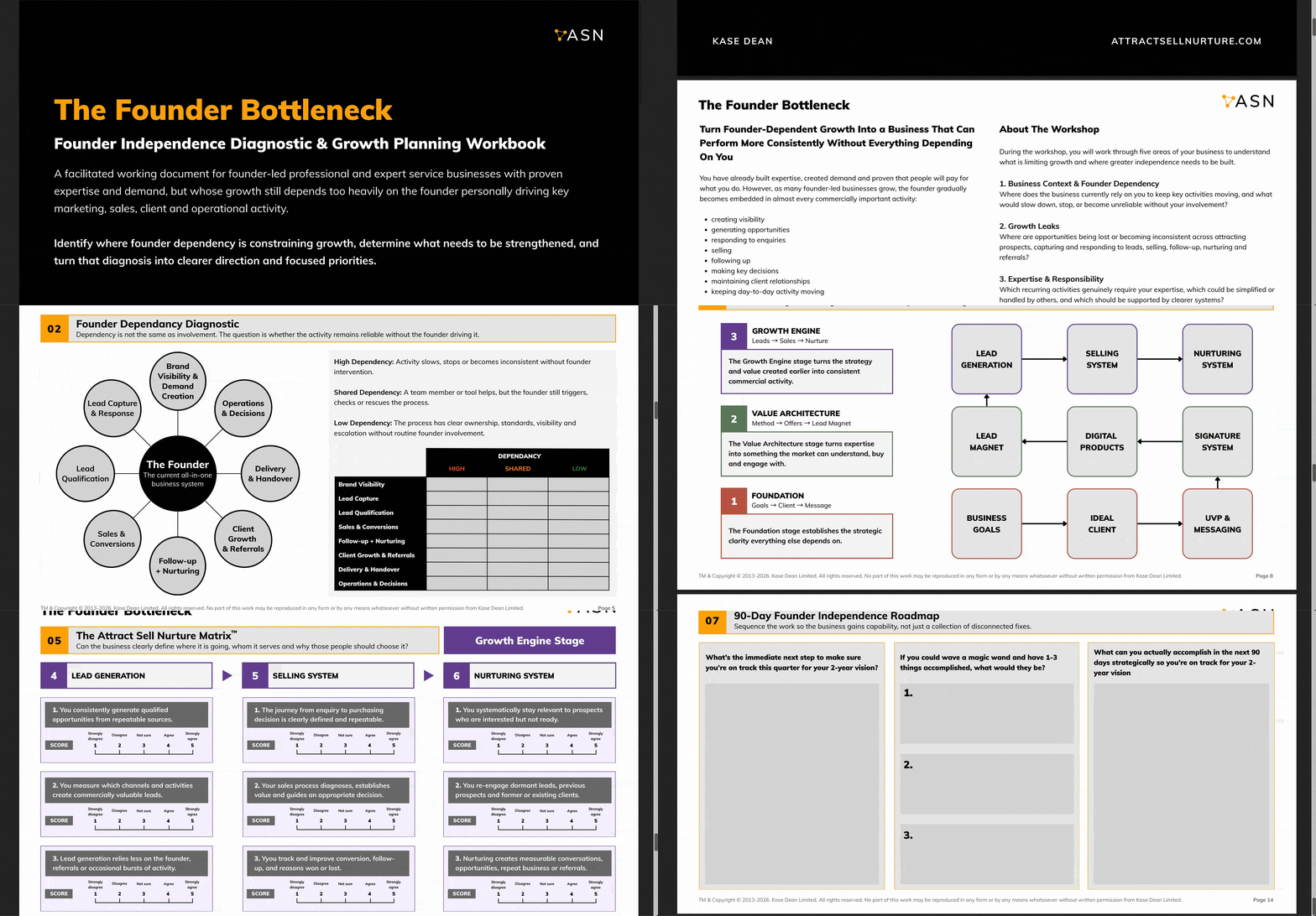
In the ASN™ System, business goals and vision sit right at the start, in the Foundation stage. Not because they are a nice warm-up, but because everything else is built on them.
Your ideal client. Your offer. Your marketing. Your sales.
First the vision, then the strategy, and only then the tools.
So here is my challenge to you.
Don’t bookmark this and promise yourself you will do it someday.
Book the hour this week.
Close your eyes, answer the money question, and see what comes up.
You might be surprised how much of your future is already in there, waiting for you to write it down.
You started this business for a reason. Let’s build one that serves you, and not the other way around.
Want help building your business vision? If you would like to talk it through with me, book a free discovery call. We will look at where you are now, where you want to get to, and whether working together is the right next step. Book your discovery call