


TL;DR: If your business can only close deals when you’re personally in the room, you don’t have a sales process yet. You have a sales personality. Here’s how to write it down so your team can run it without you.
- Your instinct, relationships, and ability to read a room are real skills… and they’re currently locked inside one person’s diary.
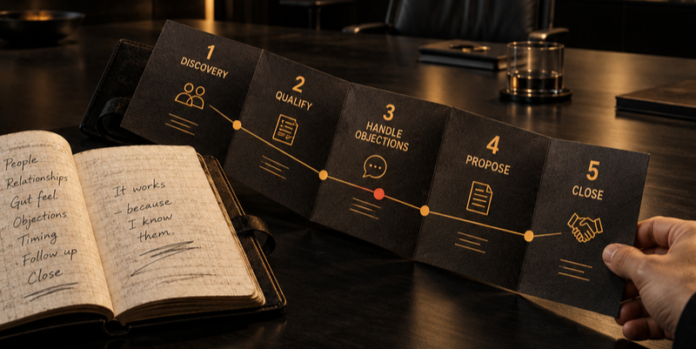
- A real sales process captures those skills as a repeatable sequence your team can follow.
- It starts with recording what you actually do, not what you think you do.
- Objections handled early stop being objections. They become proof you understand the client.
- The goal is a conversation your business can hold without you in the room.
I keep having the same conversation with established founders. They tell me their team can’t close the way they can. Deals only land when they’re in the room. So I ask them to walk me through their sales process… and what comes back is a description of themselves.
Their instinct. Their relationships. Their ability to read the moment. That’s a sales personality. It’s probably what built the business. It also means every yes routes through one person’s diary, and that’s a structural problem worth solving.
Your judgement can be written down. Here’s how to do it, step by step.
Step 1: Record What You Actually Do
Start with evidence, because your memory of how you sell is less reliable than the reality of it.
For your next five sales conversations, capture what happens. Record the calls if you can, or write detailed notes straight after. You’re looking for the sequence you follow without thinking about it.
Pay attention to three things:
- The questions you ask early, before any pitch appears
- The moment the prospect relaxes and starts telling you the truth
- What you say when you sense hesitation
Within a week, a sequence will start to show up. It’s been living in your head, doing the work quietly, and nobody’s written it down yet.
Key Point: You already have a process. This step is about making it visible so it can be taught.
Step 2: Map the Honest Conversation
Now write the conversation down as stages, from first enquiry to yes.
And I mean an honest conversation, which matters more than a clever one. The version where you find out whether you can genuinely help this person before you ask them for money. Prospects feel the difference, and so does your conscience six months into the engagement.
A workable map usually looks like this:
- Enquiry: what happens in the first response, and how fast
- Diagnosis: the questions that reveal the real problem underneath the stated one
- Fit check: the honest assessment of whether you’re right for them
- Proposal: what you present, in what order, and why
- Decision: how you make it easy to say yes… or a clean no
The stated problem is rarely the real one. Someone asks about your pricing when they’re actually asking whether they can trust you. Your map needs to handle the real question at each stage, not just the surface one.
Key Point: A sales map built on honesty does two things at once: it qualifies the right clients and quietly disqualifies the wrong ones before anyone wastes time.
Step 3: Handle Objections Before They Arrive
List every objection you’ve heard in the past year. Price, timing, “I need to think about it”, the comparison to a cheaper competitor. Then note what you actually say in response, not the polished version, the real words that work.
Now move those answers earlier in the conversation. If prospects consistently worry about implementation time, address it in the diagnosis stage before they raise it. An objection answered in advance stops being a friction point. It becomes proof that you understand them.
This is where empathy does the structural work. When someone feels genuinely seen, resistance softens on its own.
Key Point: Preemptive answers to common objections transform your process from reactive to trustworthy, and that’s a meaningful shift in how prospects experience you.
Step 4: Transfer It to Someone Else
A process that only you can run is still a personality. It just has paperwork now.
Give your map to one person on your team. Sit in on their first three conversations, and resist the urge to take over. Watch where they get stuck, because every sticking point reveals a piece of judgement you forgot to write down.
Update the map after each conversation. You’re reinforcing the load-bearing parts of the structure, one adjustment at a time.
Within a month, you’ll have something transferable. Within a quarter, you’ll have a conversation the business can hold without you in the room.
Key Point: The transfer test is the real test. If someone else can’t run it, it’s not a process yet.
Step 5: Review the Handovers, Because That’s Where Deals Go Quiet
In my experience, inconsistency rarely lives inside the stages themselves. It lives between them.
The enquiry that waited four days for a reply. The proposal that went out with no follow-up plan. The warm conversation that went cold because nobody owned the next step.
Once a month, trace three recent deals through your map and mark every handover point. Fix the slowest one first. Then the next. Incremental improvement here compounds in ways a dramatic pitch overhaul rarely does.
Key Point: Deals don’t usually die inside a stage. They go quiet in the transition from one stage to the next. Fix the handovers and you fix the conversion rate.
What You End Up With
Here’s the recap. Record your real behaviour across five conversations. Map the honest conversation from enquiry to decision. Move your objection answers earlier so they land as understanding. Transfer the map to one team member and patch the gaps their sticking points reveal. Review the handovers monthly.
What you’re building is transfer. Your judgement about who you can help, which questions do the work, and what hesitation really means… now set down as a structure your business can run.
You built the relationships that got you here. Now build the process that lets them multiply while you take an actual holiday.
Frequently Asked Questions
What is the difference between a sales personality and a sales process?
A sales personality relies on an individual’s instinct, relationships, and ability to read the room. A sales process is a documented, repeatable sequence that produces consistent results regardless of who runs it.
Why does having only a sales personality create a problem?
Because every deal routes through one person’s diary. That limits capacity, creates operational fragility, and makes it difficult to delegate or scale without the founder present.
How do I start turning my sales approach into a documented process?
Record your next five sales conversations, either on call or in detailed notes immediately after. Look for the sequence you follow instinctively, then write it down as distinct stages.
What should a basic sales process map include?
Five stages typically cover it: enquiry response, diagnosis, fit check, proposal, and decision. Each stage should handle the real question the prospect is asking, not just the surface one.
How do I handle objections within a process?
List every objection you’ve received in the last year, note the responses that actually work, then move those answers earlier in the conversation so they land before the objection is raised.
How do I know when the process is actually working?
When a team member can run it independently and produce consistent results, the process is working. If it still requires your direct involvement to close, it needs another iteration.
How often should I review and update the process?
Once a month is a workable cadence. Trace three recent deals through the map, identify the slowest handover point, and fix that first before moving to the next.
What’s the most common place deals go quiet?
Between stages, specifically in handovers. A warm conversation goes cold when nobody owns the next step. Reviewing transition points monthly is where the real conversion improvements tend to appear.
Key Takeaways
- A sales personality is a genuine asset. It becomes a structural liability when it’s the only way your business closes deals.
- Your instinctive sales sequence already exists. Recording five real conversations will make it visible.
- An honest conversation map covers five stages: enquiry, diagnosis, fit check, proposal, and decision.
- Objections answered before they’re raised become trust signals, not friction points.
- The transfer test is the real measure of a process: can someone else run it and get consistent results?
- Inconsistency tends to live in the handovers between stages, not inside them. Fix those first.
- Incremental monthly improvements to your process compound. A dramatic overhaul of your pitch rarely achieves the same result.