
If you want to start a business from an idea, the most valuable work happens before you build anything.
I call it pre-founder business building: the work you do before you have a business, when all you have is an idea, a strong sense that you could do this, and no proof yet that anyone else wants it.
It is also the best moment to get things right, because nothing has been built yet that depends on you.
Most advice on how to start a business from an idea says to build something: a logo, a website, a prototype, an app.
I want to suggest a different starting point. Before you build anything, decide what the business is for, who it is for, and what problem it solves.
Those three decisions are the Foundation stage of the ASN System, and they are what this article is about.
I have spent more than 15 years working with business owners across websites, sales, marketing, operations and automation.
The pattern I see most often when someone wants to start a business from an idea is not a bad idea.
It is a good idea turned into a business with no intentional strategy behind it, so it gradually becomes a second job.
Pre-founder business building is how you stop that from happening.
If you are a pre-founder, you have a rare advantage.
You can design the business before it exists.
By the end of this article, you will have three things: a clear description of the life your business must serve, a specific group of people you want to help, and a sentence that says what you solve in their own words.
| In short: To start a business from an idea, work through three Foundation steps before you build anything: define what the business must do for your life (Business Goals), choose the specific people you will serve (Client), and describe the problem you solve in their words (UVP and Problem-Focused Niche). |
Start a business from an idea: what pre-founder business building actually means
A pre-founder is someone who intends to start a business from an idea but does not yet have the proof that makes it one: no paying clients, no tested offer, sometimes not even a finished idea.
You might be an employee with an idea you cannot shake.
You might be returning to work after years raising a family, with experience the market does not yet see.
You might be an expert whose knowledge is stuck in your head, or a member of an incubator cohort with a promising concept and a lot of advice coming at you.
Pre-founder business building is the deliberate design of a business at that stage.
It is not a business plan, a pitch deck or a launch.
It is the thinking and the conversations that decide whether what you build later will be worth building, and whether it will fit the life you want.
The real risk at idea stage: building a second job
When people worry about how to start a business from an idea, they are actually worrying about the idea itself. Is it good enough? Has someone already done it?
In my experience, that is rarely where the damage happens.
The damage comes from early decisions nobody notices you making.
You say yes to every client because you need the money.
You keep the method in your head because writing it down feels like a waste of time. Every enquiry, sale and delivery runs through you because you are the only one who knows how.
A year later, you are the hub of everything, working harder than you did in your employment, with nobody to cover for you if you are ill or simply tired.
Pre-founder business building exists to catch those decisions while they are still easy to change.
That is a business that has taken over the founder, instead of one that serves the founder.
It can be fixed, and I have helped founders fix it, but it is far easier not to build it that way in the first place.
My own philosophy is Empathy, Strategy, Technology – in that order, always.
Pre-founders tend to start at the end of that list.
They reach for technology first: a website, an app, an automation…AI.
The Foundation stage puts the order right.
Empathy for the people you serve, and for your own life, comes first.
Strategy comes next, built on what you learn.
Technology comes last, once there is something worth carrying.
Step 1: Business Goals – decide what your business is for
The first step of the ASN System is Business Goals, and in pre-founder business building, it is the one most often skipped.
When you start a business from an idea, the idea feels urgent and personal, so people jump straight to what they will build.
Step 1 asks a harder question: what do you want this business to give you?
Start with Point A and Point B
Point A is where you are today, personally and professionally. Point B is where you want to be. I use these two points at the start of every piece of work because they stop a business from being built in a vacuum. Write both down in plain language, and be specific about the life, not just the business.
- How many hours a week do you want to work, and when?
- What income does your life need, and by when?
- Who and what must the business leave time for: family, health, other commitments, rest?
- What do you want your days to look like in three years?
- What would make you walk away from this business, and what would make you proud of it?
None of these are marketing questions.
They are design questions, and they decide the shape of everything that follows.
A founder who needs flexibility around school hours will build a different business from one who wants to work in intense bursts and take long breaks.
Separate the cause from the life
Many pre-founders arrive with a cause. They have seen something that needs to change, and they want to fix it.
That is a good place to start, and it is not yet a business.
I recently met a woman who had spent five years raising her children before returning to work.
She found that her CV no longer reflected the value she could bring, and she wants to build a product that helps people draw out the overlooked experience in their own lives.
It is a good idea with a real problem behind it.
Before we talked about the product, though, the useful question was Step 1: what does she want for her own life?
Does she want to run a software company, or does she want to help people see their worth, with software as one way to do it?
The answer changes every decision that follows.
The same question mattered for a client I worked with years ago, who wanted to improve how schools support children through coaching for pupils, teachers and parents.
Her cause was powerful.
What changed things was separating what she wanted to fix in the world from what she wanted for her own life.
The business we built on that answer was still running six years later, including through a period when she could not be there.
Learn more about Karen Cruise and Flourished Minds CIC here (The website was built by ASN).
Write a one-page brief
Finish Step 1 with a single page.
It should state your Point A, your Point B, the life the business must serve, and the impact you want it to have. Keep it where you will see it.
When a tempting opportunity arrives, test it against the page.
Does this move me toward the life I described, or does it pull me into a job I did not choose?
This is also where you decide what lasting impact means.
An impact bigger than you cannot rely on your constant presence. If the business only works when you are in the room, its reach stops where your energy does.
Writing that down now means you design for it from the start, instead of trying to remove yourself later.
Step 2: Client – choose the people you will serve
Step 2 is Client. In pre-founder business building, the client is usually described as a broad group: small businesses, parents, young people, professionals.
Those are demographics, not people.
Step 2 asks you to describe one specific type of person well enough that you could recognise them in a room.
I learned the importance of this early.
I started as a WordPress web designer, and after I delivered a website, my client asked me, “How do I get clients?”
I had built exactly what they asked for without ever asking who it was for.
That question took me into behavioural marketing, why people buy, personalisation and automation, and it has shaped how I work ever since.
The lesson is simple: build for a person, not for a product.
There is a second reason Step 2 belongs in the Foundation.
The people you choose to serve shape your working life. If you serve people you enjoy and respect, the business supports your life.
If you chase whoever will pay, you can end up spending your days with clients who drain you.
Choose people you would be glad to spend your working life with.
Have five honest conversations
The fastest way to validate a business idea is to talk to five real people who might have the problem, before you build anything.
When you start a business from an idea, five honest conversations tell you more than any plan.
This is not a sales call, and you are not pitching. You are listening. These five questions are a good place to start:
- Tell me about the last time this problem came up for you.
- What did you try to do about it?
- What did that cost you, in time, money or stress?
- What would change in your life if it were solved?
- Who else do you know who deals with this?
Write down the words they use, exactly as they say them.
You will need them for Step 3. If you find yourself explaining your idea, stop and ask another question.
What if the conversations challenge your idea?
Sometimes the conversations show that the problem is smaller, different or less painful than you assumed. That is a good result.
Finding it out in a week, for the price of a few coffees, is far better than finding it out after six months of building.
It usually points to a better version of the idea: the same people with a sharper problem.
Keep a simple record
Keep a list of everyone you speak to, what they said, and what you promised to follow up on. A spreadsheet is enough.
This is your first CRM, and it matters more than any software. Tools and automation can come later, once you know what is worth automating.
Step 3: UVP and Problem-Focused Niche – say what you solve in their words
Step 3 turns your conversations into a clear statement of value. Two ideas sit inside it.
Your unique value proposition, or UVP, is the specific value you offer and the reason someone would choose it.
A problem-focused niche means defining who you serve by the problem they have, not only by their industry or age.
Why start with the problem?
People do not wake up looking for your solution. They wake up with a problem they can feel.
When your message names that problem in their language, they recognise themselves, and marketing starts to feel like recognition instead of persuasion.
Use their words, not yours
Go back to your five conversations and look for phrases that came up more than once. Pre-founders often describe their idea in the language of the solution: platform, app, AI-powered, framework.
Customers describe the problem: I never have time, I do not know where to start, I cannot see my own value. Borrow theirs.
A simple formula to start with
Try completing this sentence:
I help [specific person] who [problem in their words] to [result they want] without [the thing they are afraid of].
Read it back to the people you spoke to.
If they say “that is exactly me”, you have something. If they ask “so what do you actually do?”, rewrite it. It will take several attempts, and each attempt teaches you something.
Why a clear problem statement lets the business outgrow you
There is a deeper reason to do this properly.
Good pre-founder business building produces a sentence that clearly names a problem, and a sentence like that is one that other people can repeat.
A partner can explain it, a future team member can sell it, and a customer can pass it on to a friend.
A business that depends on your personal explanation of what it does will always depend on you.
How the three steps build a business that is bigger than you
Taken together, the three Foundation steps of pre-founder business building give you more than a clear way to start a business from an idea.
They set the direction of the business in four ways:
- It serves your life. Step 1 defines what the business must give you, so every later choice has a test.
- It makes a real impact. Steps 2 and 3 point you at a genuine problem that real people have named, and that is what lasting impact is built on.
- It is bigger than you. A clear person, problem and purpose give other people something to join: partners, team members, and customers who refer others.
- It can be separated from you. Because the thinking is written down, the goal, the message and the method can be taught and handed over. You become the founder, not the bottleneck.
None of this needs a budget, software or a launch date. It needs a few weeks of careful thinking and real conversations, which is exactly why pre-founder business building is such a good use of this stage.
It is also how you start a business from an idea and build a business that serves your life from the first day, instead of trying to win your life back later.
Is a business that serves your life just a lifestyle business?
A lifestyle business is usually described as a business designed to support the owner’s preferred way of living, with a focus on income and work-life balance instead of rapid growth.
That is close to what Step 1 asks you to define, so it is fair to ask whether this approach simply produces a small business.
It does not have to. When you start a business from an idea, the usual choice between a lifestyle business and a growth business is a false one. A lifestyle business that depends entirely on you is capped by your hours.
A business designed around your life from the beginning, with a clear client, a named problem and a method that is written down, can grow, take on a team and make a wider impact, precisely because it does not need you at the centre of everything.
The difference is design.
A business stays small when the founder is the only way the work gets done.
A business built through these three Foundation steps starts with your life as the brief and separation from you as the goal.
You decide how big it becomes, and your life stays the measure of whether it is working.
Questions people ask when they start a business from an idea
I have a business idea. Where do I start?
To start a business from an idea, begin with Step 1. Write down the life you want the business to give you, then choose the person you want to serve and talk to five of them. Do not start with a website, a logo or a business plan. Those come later, and they are far easier to get right once the Foundation is in place.
Do I need a business plan before I start?
Not yet. Many guides on how to start your own business begin with registering a company and writing a plan. Registration, tax and company structure matter, and GOV.UK explains how to set them up, but they are easier decisions once you know your client and your problem. In pre-founder business building, a traditional plan is hard to write well before then. Start with the one-page brief from Step 1, your five conversations from Step 2 and your problem statement from Step 3. A plan built on those is far more useful.
How long does the Foundation stage take?
To start a business from an idea this way, allow roughly a month alongside other commitments. The writing takes a few hours. Most of the time goes on arranging and holding the five conversations, and on rewriting your problem statement until the people you speak to recognise themselves in it.
Should I build a website or an app first?
No. Conversations first, tools later. If you start a business from an idea by building first, you are building on guesses. Once you have a clear client and problem, you will know what is worth building, and the first version will be smaller and cheaper.
Can I start a business from an idea with no money?
Yes. The Foundation stage costs time, not money. If you are wondering how to start a business with no money, begin here: writing your one-page brief, holding five conversations and drafting your problem statement need no budget, no software and no company registration. Spend money later, once the conversations show that people will pay.
What if my idea changes after the conversations?
Then the process is working. Most ideas change once they meet real people. The aim is not to defend your original idea. It is to build the right business for the life you want, serving people who need it.
Can I use AI tools at this stage?
Yes, for preparation: drafting interview questions, organising notes, testing wording. Do not use them in place of the conversations themselves. Empathy comes first, and it cannot be automated.
Where these three steps lead: the ASN System
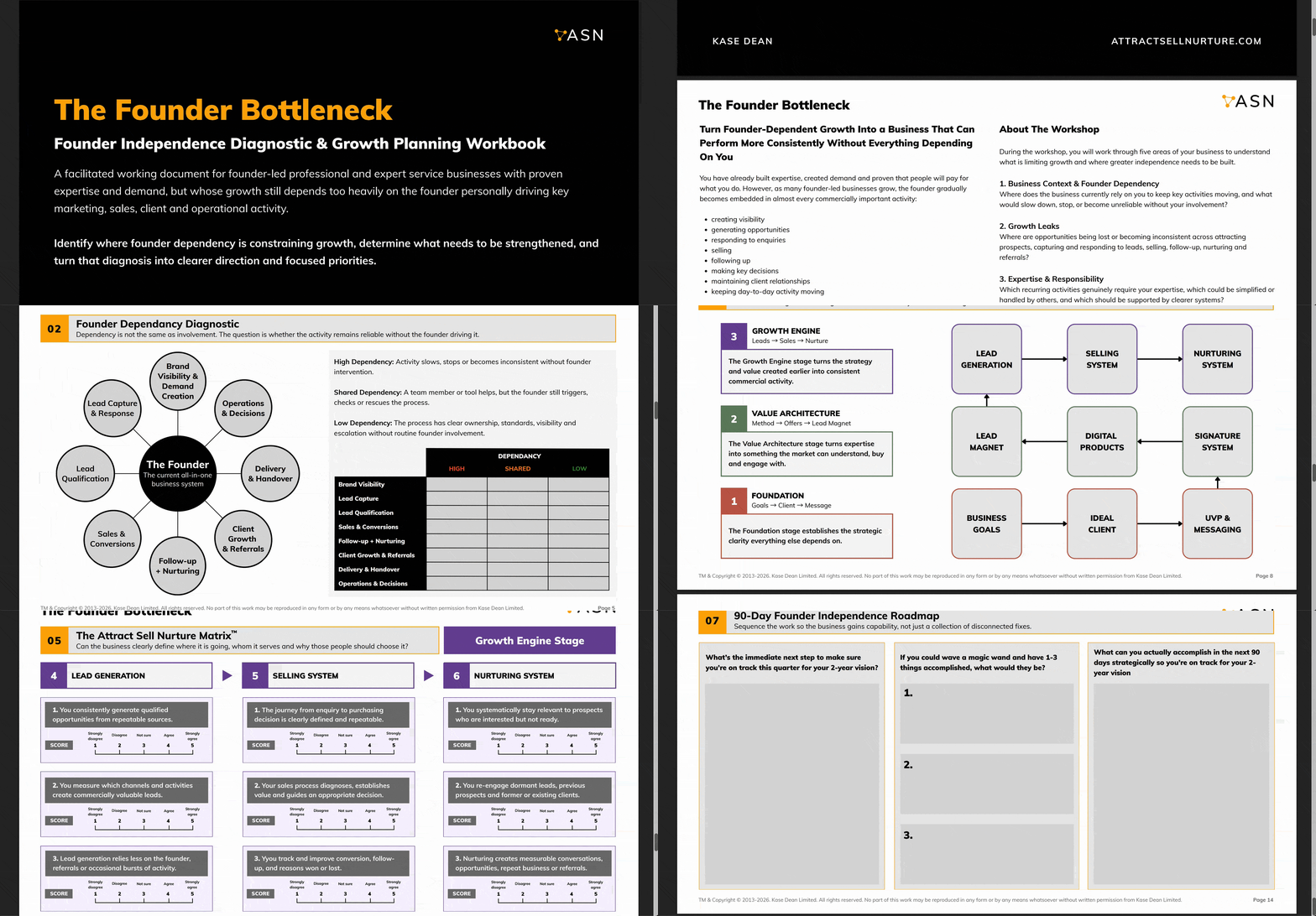
The three steps in this article, Business Goals, Client, and UVP and Problem-Focused Niche, are the heart of pre-founder business building, and they are Stage 1 of the ASN System.
ASN stands for Attract, Sell, Nurture. It is the nine-step system I have developed and refined over more than 15 years of working with founders, and it is the structure behind everything I do.
What it is. The ASN System is nine steps in three stages:
- Foundation builds clarity before tactics: Business Goals, Client, and UVP and Problem-Focused Niche.
- Value packages your expertise into something people can buy and use: Signature System, Digital Products, and Entry Offer.
- Growth turns attention into customers, and customers into lasting relationships: Lead Generation System, Simple Selling System, and Lead Nurturing System.
How it works. The steps are installed in order. Clearer positioning leads to sharper offers, sharper offers make lead generation easier, and easier lead generation makes growth repeatable. Each step gives the next one something solid to stand on. In pre-founder business building, that means the marketing and selling come when there is something proven to market and sell, not before.
Why it works. It removes the usual causes of a founder-dependent business before they can form. It starts with your life, not with tactics. It puts people before technology. It writes things down so they can be shared.
And it moves at the pace of evidence: you take the next step when the last one is proven, not when you feel ready.
It gives you a way to start a business from an idea without guessing. I use the same system with established founders to take them out of the middle of everything.
Pre-founder business building is simply the same system at its earliest point, and far easier to apply.
I do not believe in hype or pressure. What I offer is a clear structure and a straight conversation about where you are and what to do next.
Book a discovery call
Pre-founder business building is easier with someone alongside you. If you want to start a business from an idea you believe in, I would like to talk to you.
On a discovery call, we will look at where your idea stands against the three Foundation steps, what the life you want from this business really needs, and the one next step to take first.
It is 30 minutes. There is no pitch deck and no pressure. You will leave with a clearer view of your Point A, your Point B and what to do next, whether or not we ever work together.
Your idea deserves a business that is built properly, and you deserve one that gives you your life back instead of taking more of it.
Book your discovery call here and let us start with your Success Foundation.