


TL;DR: Your existing clients are your most efficient growth lever. A nurture system keeps those relationships alive and valuable without you personally managing every touchpoint. Build it once, refine it quarterly, and your business starts growing on its own terms.
- Losing touch with past clients is a structural problem, not a personal failing.
- A nurture system is a planned rhythm of touchpoints that deliver value after the sale.
- Every touchpoint needs an owner that isn’t you, or an automation that doesn’t require you.
- Quarterly review keeps the system improving without requiring a full rebuild.
- When it works, referrals arrive without chasing and past clients return on their own.
The thing I’m beginning to notice in established service businesses is this: the most efficient growth lever you own is the client who already trusts you. You’ve done the hard work. You’ve delivered. The trust exists. And in many businesses, it sits there untouched while the owner pours hours into finding strangers.
Here’s the step-by-step for fixing that.
Step 1: What’s Actually Causing the Silence After the Sale?
Before you build anything, get honest about why past clients go quiet.
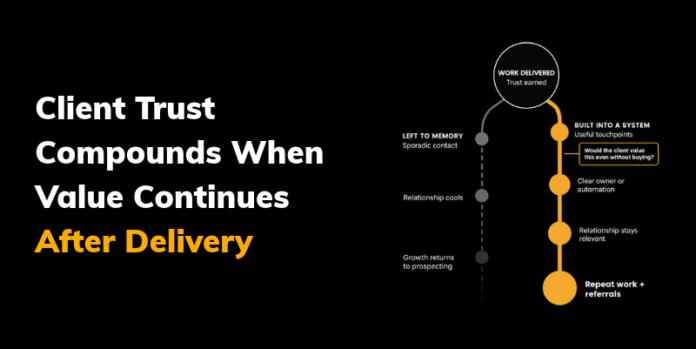
In my experience, it’s rarely because they stopped valuing you. It’s because staying in touch depended entirely on you personally remembering to do it. When your diary filled up, the follow-ups stopped. That’s a structural problem, and structure is fixable.
You can’t be the load-bearing wall of your own client relationships forever.
Write down every touchpoint a client currently receives after the sale. If the list is short, or if every item is something only you can do, you’ve found your starting point.
Key Point: Losing touch with past clients is almost always a structural problem, not a discipline problem. If it depends on you remembering, it will eventually stop.
Step 2: How Do You Define What “Staying Valuable” Actually Means?
A nurture system is a structured commitment to staying present, relevant, and valuable after the sale. The word that matters most is valuable.
Sending a generic newsletter nobody reads keeps you visible without keeping you useful. So start with empathy before strategy… It’s the sequence I hold to in everything I build.
Ask yourself:
- What problems do your clients face six months after working with you?
- What would genuinely help them, even if it earns you nothing this quarter?
- What do they wish someone would check in about?
Your answers become the raw material for every touchpoint that follows.
Key Point: Value is defined by the client’s situation, not your content calendar. Start there, and the rest becomes clearer.
Step 3: How to Map a Touchpoint Rhythm That Actually Holds
Now turn those answers into a planned rhythm. Keep it simple. A workable starting structure looks like this:
- 30 days after delivery: a check-in on how the work is holding up.
- Quarterly: one piece of genuinely useful insight relevant to their situation.
- Twice a year: a review conversation about what’s changed in their business.
- Ongoing: a way for them to reach you easily when something new comes up.
Each touchpoint should pass one test: would the client be glad this arrived, even if they never bought again? If yes, it belongs in the system. If no, cut it.
Key Point: A rhythm only works if each touchpoint earns its place. One strong check-in outperforms five forgettable emails.
Step 4: How to Remove Yourself From the Delivery
This is the step that changes how the business actually functions, and the one most founders skip entirely.
Every touchpoint you mapped needs an owner that isn’t you, or an automation that doesn’t need you. Templates handle the check-in emails. A calendar system triggers the review invitations. A team member runs the quarterly insight. Technology works beautifully here because it multiplies clarity… you’ve already thought, so the tools simply carry it out.
Feed a system confusion, and it produces chaos at scale. Feed it a clear plan, and it produces consistency without your constant attention.
Key Point: Systematising your touchpoints isn’t about removing the human element. It’s about making sure the human element actually shows up, every time, without depending on your memory.
Step 5: How to Review the System Without Rebuilding It Every Quarter
Set a fixed point every quarter to look at what the system produced. Which touchpoints prompted conversations, which led to repeat work or referrals, which landed flat.
Adjust and carry on. Incremental, compound improvement wins here… small refinements each quarter build something remarkably solid over a year.
Then comes the harder discipline: let it run. Resist the urge to personally intervene in every relationship. The measure of success is whether client relationships stay warm when you step back.
Key Point: A quarterly review keeps the system sharp without turning it into a project. Refine one thing, trust the rest.
What This Builds Over Time
Founders who do this properly describe a shift in how their business feels. Growth stops depending on their daily presence. Referrals arrive without chasing. Past clients return because the business stayed genuinely useful to them, on its own.
To recap the five steps: diagnose where after-sale contact currently depends on you, define what valuable means to your specific clients, map a planned rhythm of touchpoints, hand the delivery to systems and people, and review quarterly while trusting the structure to work. The trust you’ve already earned is the most efficient asset in your business… a nurture system is simply the structure that keeps it alive without consuming your hours. Build it once, refine it steadily, and your business grows with you instead of on top of you.
Frequently Asked Questions
What is a client nurture system?
A client nurture system is a structured, planned sequence of touchpoints that keeps your business relevant and valuable to past clients after the sale, without requiring you to personally manage every interaction.
Why do past clients go quiet after a project ends?
In the majority of cases, it’s a structural issue. Staying in touch depended entirely on the founder personally remembering to follow up. When other priorities filled the diary, follow-ups stopped. The relationship didn’t decay because of disinterest; it decayed because there was no system holding it in place.
How often should you contact past clients?
A workable rhythm includes a check-in 30 days after delivery, one piece of genuinely useful insight each quarter, and a review conversation twice a year. The exact frequency matters less than the consistency and quality of what you send.
What should a nurture touchpoint actually contain?
It should pass one test: would the client be glad it arrived, even if they never bought again? Useful insight relevant to their current situation, a genuine check-in on how things are going, or a conversation prompt about what’s changed in their business. Generic content that serves your visibility over their needs belongs elsewhere.
How do you remove yourself from client nurture delivery?
Templates handle check-in emails. A calendar system triggers review invitations. A team member or VA runs the quarterly insight delivery. The thinking is done once, upfront. The tools and people carry it out consistently from there.
How long does it take for a nurture system to produce results?
That depends on the quality of the relationships you’re nurturing and the value of the touchpoints you’re delivering. Anecdotally, founders who implement a clear, consistent rhythm often notice referrals and repeat conversations within the first two quarters. Compound improvement builds from there.
Is a nurture system the same as email marketing?
Not quite. Email marketing is typically broadcast-focused and volume-driven. A nurture system is a structured, relationship-first commitment to staying genuinely valuable to specific clients over time. The delivery might use email, but the logic and intent are fundamentally different.
What’s the difference between a nurture system and just staying in touch?
Staying in touch depends on you remembering. A nurture system doesn’t. The structure runs whether you’re present or not, which is the whole point.
Key Takeaways
- Your existing client relationships are your most efficient growth lever, because the trust is already there.
- Losing touch after the sale is almost always a structural problem, fixable with a planned system rather than more personal effort.
- Define what “valuable” means through your clients’ lens first, then build the touchpoints around that.
- Every touchpoint in the system needs an owner or automation that isn’t you, because consistency can’t depend on your memory.
- Quarterly reviews keep the system improving incrementally without requiring you to rebuild it.
- The measure of success is whether client relationships stay warm when you step back entirely.
- A nurture system doesn’t replace the relationship. It makes sure the relationship actually survives your busiest months.