

You believe your unique selling point lives in what you sell: the service, the price, the quality and rightly so, because that is where every guide on the subject tells you to look.
But when I speak to an Owner-Operator, I always find the same thing…
They can do the work brilliantly and still need ten minutes to explain why anyone should choose them.
They fall back on “quality” and “customer service” because everyone else does.
They drop the price when a sale gets tight. They borrow a competitor’s wording because their own never quite fits.
None of that is a copywriting problem. It is a clarity problem, and it starts further back than your website.
This guide gives you another way to find your unique selling point, and it starts with you.
What is a unique selling point (USP)?
A unique selling point, also called a unique selling proposition, is the reason a customer chooses you over the alternatives. That is the USP meaning in one line.
The textbook version says it is a distinctive feature or benefit of your product or service: a price, a speed, a guarantee, a process.
That is fine, and it is understandable. When there is a product on a shelf, the product can carry the difference.
But if you are an Owner-Operator selling your expertise, the thing on the shelf is you.
Why “quality” and “customer service” are not a USP
Every competitor claims them. A claim everyone makes cannot separate anyone from anyone.
Try this. Take the wording from your home page and imagine it on the site of the nearest rival.
If nobody would notice the swap, it is not a unique selling point. It is a placeholder.
You can build on a placeholder for a while. Foundations like that crumble the moment the business has to carry real weight, and you are the one standing on top of it when they do.
The USP is you
I’ve said this before, and I’ll say it again: the USP is you. Not the unique selling proposition.
The you, even though you begins with Y, is you.
That might sound a little woo-woo. It is not.
Think about what a competitor can copy. They can copy your price, your process steps, your tagline and your tools.
They cannot copy how you make a decision, what you will and will not take on, or the reason you started the work in the first place.
Those are your judgment, your experience and your reasons.
In a business where you are the one delivering, they are the difference a client is buying, whether you have ever put a name to it or not.
What goes wrong when you skip it
If you are not clear on who you are, what you want and why you are doing it, the business does not work properly afterwards.
What happens instead is that you start looking outside for the answer. Investment. Another adviser. A new tool. AI.
In small ways and big ways, you hand the growth of the business, the very birth of it, to someone or something else.
Faster tools do not fix unclear foundations. They amplify them.
It is like making decisions when you are angry or tired, only now you can act on them faster.
I know some people will read that and think I am being a little alarmist.
But what I think is at stake is the human side of the business, and that is the part you cannot delegate before you have made sense of it yourself.
A real example: the founder as the difference
The Body Shop opened its first shop in Brighton in 1976.
Case studies of the company describe a founder, Anita Roddick, whose personal convictions shaped day-to-day operating decisions, rather than sitting in a mission statement added later.
One example is sourcing ingredients directly from small producer communities, an approach that became known as Community Trade.
The difference did not come from a clever tagline. It came from who she was and what she would not compromise on.
You do not need a global brand for the same principle to work.
At the scale of an Owner-Operator business, it can be as simple as being clear about the kind of work you will do, the kind of client you will do it for, and why.
Find your unique selling point: three questions
Before you write a tagline or brief anyone, answer these.
- Who are you in this business? What have you lived through, got good at and refuse to do?
- What do you want from the business? Not only a revenue number. The hours, the clients, the work and the life it is supposed to give you.
- Why are you doing it? Not the situation (“I needed the income”) but the experience and the emotion that moved you from one way of thinking to another.
Put your three answers into one plain sentence. That sentence, not a slogan, is your starting point.
A slogan can come later, and it will be easier to write.
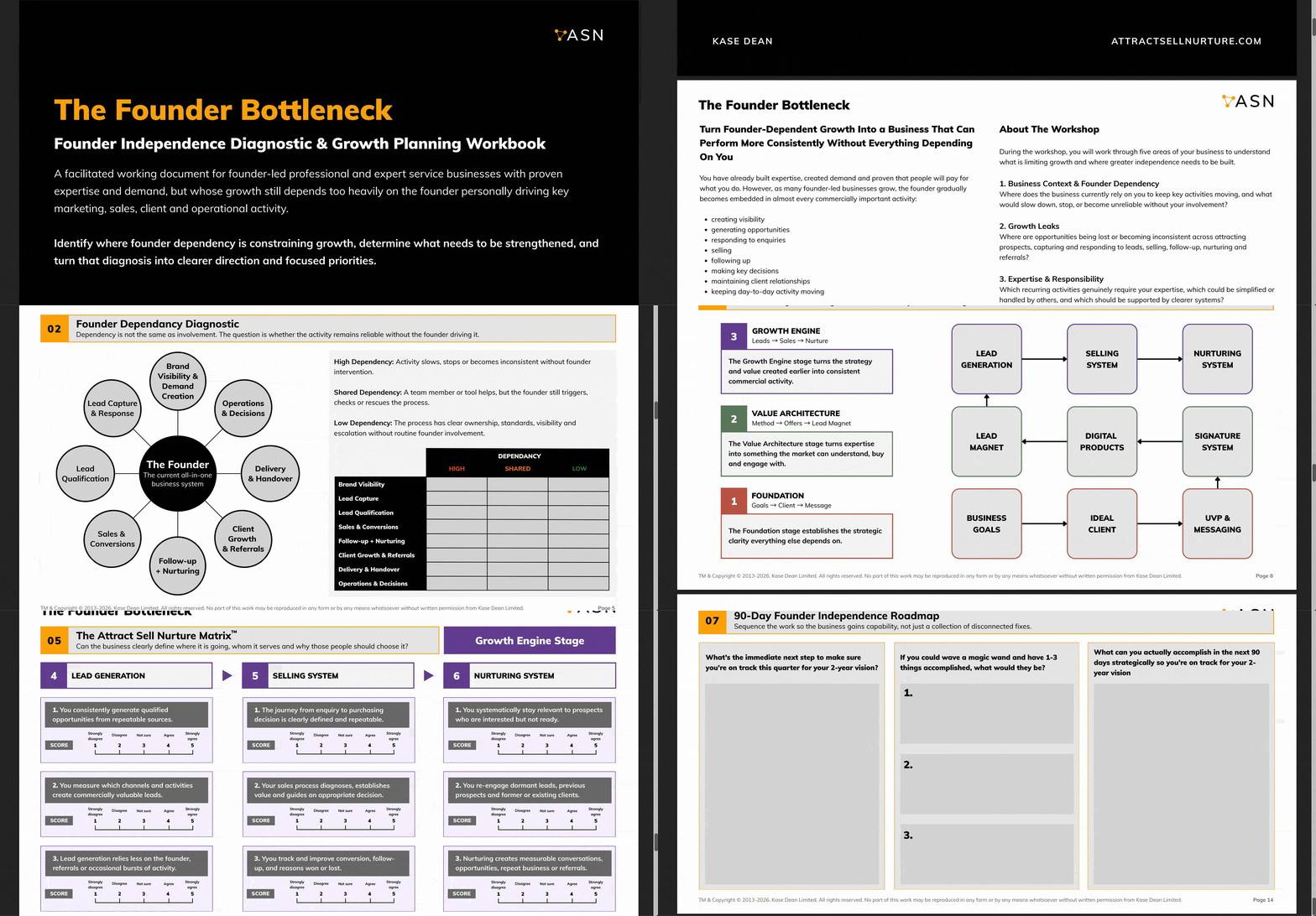
This is the foundation work at the heart of the ASN System: goals, ideal client, message. It comes first because clarity makes everything after it sharper.
Start with you
When you are your own unique selling point, the first job is to be team you. Not team anybody else first.
That means getting clear on what the business is supposed to do for you, then building the marketing around it.
If you want help getting there, book a free 30-minute Growth Systems Call.
Sources