
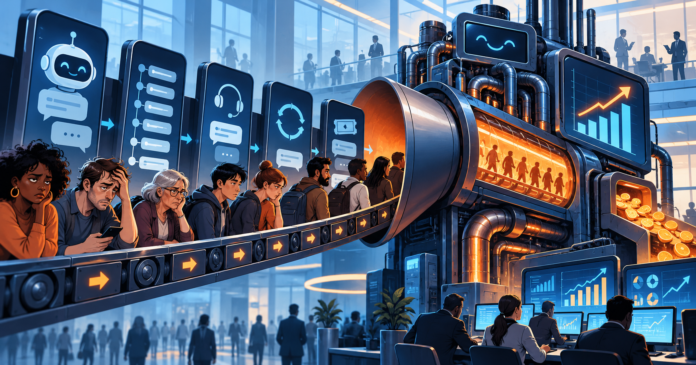
We were never asked whether we wanted a script in place of a person. Companies have decided that customers are the fuel of the money machine rather than the reason for it, and the chatbot is only the clearest sign that bad customer service is now a business model.
You know the routine by now. A cheerful greeting from something that is not a person turned quickly into an answer to a question you did not ask.
A menu that loops back to where you started, and a sympathetic line, delivered by software that feels nothing, about how sorry it is that you are frustrated. Somewhere behind it all, nobody is available. Nobody was ever meant to be.
Bad customer service used to be a failure. Something went wrong, a customer complained, and somebody was embarrassed enough to put it right.
Now it is a design choice, built in, budgeted for and measured, and the person on the receiving end is expected to put up with it.
I do not think we were ever asked. There was no moment when customers were offered a choice between a person and a script.
It arrived a piece at a time: a phone menu here, a contact form there, a help centre that took the place of the help. Each change was small enough to shrug at, and each one made the next easier to swallow.
That matters far beyond the irritation of a wasted afternoon. A company that stops being reachable is making a statement about what it thinks you are, and we have accepted that statement for too long.
We Had No Choice, Which is Why It Was Never Fine
When every bank, utility, airline and software vendor does the same thing, there is nowhere left to go. That is not consent. It is exhaustion. We accepted it because we had to, and that is precisely why it was never acceptable.
Change of this kind works like a ratchet. A company removes the phone line because the chatbot can handle the basics. A competitor, watching the savings, does the same.
Then the chatbot is asked to handle the harder cases, because it is already there and the person who used to handle them has gone. Each step is defended by the one before it.
No one has to decide on the destination, because it is reached through a hundred reasonable-sounding decisions, none of which is anyone’s fault.
Look at what has actually changed. The work has not disappeared. It has been handed to us. We search the site for an answer that is not there, fill in the form, describe the problem again to the third stranger, and wait.
Add up the minutes, and the cost has not been removed from the system at all. It has been moved to a place where it appears on no balance sheet: the customer’s afternoon.
Somewhere along the way, the option to talk to a human stopped being a given and became something to hunt for.
We trade the tricks like contraband: press zero, say the word agent, say it again, pretend to be calling about a new purchase because the sales line still has a person on it.
The company calls this self-service. It is the same labour, with the customer doing the job.
There is also a question of power, which is rarely said aloud. When a company puts a bot between itself and its customers, it decides how much of its own time to spend and how much of yours.
Its hours are costed, and yours are free. It can leave you in a queue for as long as it likes, because your waiting appears nowhere in its figures.
It is a relationship between a party that counts its minutes and a party whose minutes are taken without anyone saying so.
Your Call is Important to Us
Your call is important to us. The sentence has been played to so many of us, over so many minutes of hold music, that it has become a kind of joke. It is worth pausing on, because it shows where this started.
The vocabulary of care arrived long before the substance went. We value your feedback. We are experiencing higher than usual call volumes. Your satisfaction is our priority. Each is a promise that nobody in the building is in a position to keep.
The chatbot inherits that language and polishes it. It apologises with perfect grammar. It thanks you for your patience in the same tone whether you have waited a minute or an hour.
It is built to sound as if it cares, which is a different thing from caring, and the gap between the two is exactly where the insult lies.
A person who cannot help you but says so is being honest. A system designed to sound sympathetic while helping you as little as possible is being something else.
This is Not About The Chatbot
It would be easy to blame the chatbot, and easy to be wrong. The chatbot is a symptom. The decisions behind it were taken long before it arrived, by people looking at a spreadsheet.
The business measures what it can count: cost per contact, tickets closed, handling time. It notices that a human costs more than a script. The human goes. Only then does anyone ask what was lost, and by that point the customer has usually left too.
There is an old rule that when a measure becomes a target, it stops being a good measure. Customer service is a textbook case. Take deflection, the share of enquiries that never reach a person.
As a way of understanding how well a business is helping people, it might tell you something. As a target, it rewards making the human harder to find. A customer who gives up and goes away counts as successfully deflected. The dashboard shows green. Nobody has been helped.
I have worked in customer service, and I know the difference between following a script and solving a problem. The first is a way of protecting yourself. The second is a way of helping someone. One of them can be counted. The other is the only one that matters to the person with the problem.
Automation is not the offence.
The offence is what companies choose to optimise: the cost of the conversation rather than the outcome of it.
A five-minute call that settles a problem for good is cheap. A thirty-second chat that settles nothing, repeated four times, is not. Yet only the chat looks like a saving, because the dashboard counts contacts and not outcomes.
When Churn Became Normal
Customer churn is a gentle word for people walking away. It comes from subscription businesses, where it describes customers who cancel, and it has since spread into businesses of every kind, treated as an ordinary cost of trading.
Customers leave, new ones are bought to replace them, and the machine turns. When leaving is priced in, caring becomes optional.
The economist Albert Hirschman, writing in 1970, described two things a dissatisfied customer can do. They can leave, or they can speak up. He called them exit and voice.
A healthy organisation hears the voice and mends itself. What we have built is a world in which voice has been engineered away. The complaint form leads nowhere, the chat window answers itself, the phone line is a recording.
That leaves exit as the only way left to be heard, and exit is then recorded as churn and written off as a normal cost. The business has not learned what was wrong. It has simply noticed that someone left.
It is a strange kind of arithmetic.
It’s an old adage that “winning a new customer costs more than keeping an existing one”, and yet the person whose job was to keep them is among the first to be cut. We say we value loyalty. We have stopped paying anyone to earn it.
We used to say the customer is king. Nobody says it now, and no business behaves as if it were true. The customer is fuel.
Their life, their reason for buying, what they were hoping for, all of it counts until the sale clears and not a moment after.
The person becomes a conduit. Money passes through them, and anything that gets in the way – a complaint, a question, the need for another human being – is friction to be stifled. That is how poor customer service stops being an accident and becomes a strategy.
The Cult of The Frictionless
Behind much of this sits a belief that friction is always a fault. Technology people speak of removing friction as though it were self-evidently good, and for the purchase button that is fair enough.
No one enjoys fighting a checkout. But care is a kind of friction. It is the pause in which somebody listens. It is the extra question that turns out to matter. It is the minute taken to notice that this customer is not like the last one.
A business that sets out to remove every moment of human friction from the customer journey has to remove those moments too. What is left is smooth and efficient and has nobody in it.
It works perfectly right up to the point where something goes wrong, which is the point at which the customer most needs somebody to be there.
What Goes Missing When Nobody is There
A conversation with a customer is worth more than the cost of having it. It is information. A good customer service team is the cheapest research department a company will ever have. Every complaint says what the product does badly.
Every strange question says what the website failed to explain. Every request for an exception shows where a policy runs against common sense.
Remove the people and the information stops arriving in the very place where it was at its truest. A transcript that no one has time to read is not listening.
Then there are the people the script was never written for. Someone closing the account of a relative who has died. Someone whose circumstances changed overnight and who needs an arrangement that is not on the drop-down menu.
Someone elderly, or without a reliable connection, for whom typing into a box is itself the barrier. A menu offers options. A life does not come in options.
And there is trust, which is built in the moments when something goes wrong. A company that fixes a problem well can leave a customer more loyal than if nothing had gone wrong at all.
A company that makes you fight a machine for the same outcome teaches you something too. It teaches you what you are worth to them.
The people who remain are not spared. A person handed a script, a timer and no authority is being used as a slower, more expensive chatbot.
They absorb the anger of customers they have no power to help, and they are measured on how quickly they can end the call. That is a human being treated as a component, and it is the same attitude, pointed in a second direction.
Service as Software, and Software That is Not Fit For Service
For years the promise was software as a service: tools that worked for the people using them. The arrow has swung round. We now have service as software, in which the advice, the answer and the care are themselves handed to a program.
That might be defensible if the program were any good. Too often it cannot make an exception, cannot read a situation, cannot accept responsibility and has no authority to fix what it finds.
What makes a human agent worth having is not that they know more than the software. It is that they are allowed to decide.
A refund, an exception, an apology that costs something: these are acts of authority. A system built to avoid cost will never be given any, so it can only ever commiserate.
A service that cannot serve is software with a friendly name. Setting it in front of a customer in difficulty and calling that support is not innovation. It is avoidance.
The Opportunity That Was Thrown Away
It did not have to be like this. Customer service AI could have been extraordinary.
Imagine it taking the routine off a team, answering the simple questions instantly and correctly at three in the morning, so that people had the time to give the hard conversations their full attention.
Imagine it passing every detail along, so that the person who picks up already knows the history and says “I can see what has happened here” instead of asking you to confirm your date of birth for the fourth time.
Imagine it being judged on whether the problem was solved rather than whether a human was avoided. Imagine a business feeling closer to its customers because of the technology, not further away.
None of this needed a new invention, only a different instruction. The same technology that deflects a customer can be set to recognise distress, to spot a repeated failure, to tell a person in the building that this one needs them now.
The tools are neutral about what they are pointed at. It was people who decided where to point them.
That was on the table. The attention went to the technology and to the customer’s wallet, in that order, and the person was left to cope.
Money Cannot Be the Only Thing That Matters
The sensible reply is that this is simply business. Labour is expensive, margins are thin, competition does not wait, and sentiment is not a line on the accounts.
All of that is true, and I would not ask any company to ignore its costs. I am saying that the savings are borrowed. What is saved on the support line is paid for in goodwill, and goodwill does not show up on a balance sheet until it has gone.
There is a version of this that is better business too. A company known for answering the phone has an advantage that cannot be bought with software, because a competitor can license the same chatbot next week.
What cannot be licensed is a reputation for having treated people decently when it was inconvenient. In a world where every service is smoothed into sameness, being reachable becomes a point of difference.
None of this is an argument against money. Businesses have to pay their way. But when every decision is filtered through the finance line, care is the first thing to go, because it is the hardest thing to put a number on.
To ask for more than that will sound sentimental. I make no apologies for it.
A customer is a person with a life, a worry, a deadline and a budget that does not stretch. Nobody should have to accept being handled, and we should stop pretending that it is normal.
Bad customer service is a choice somebody made. Which means somebody can unmake it.
Before You Cut The Human Out of Your Own Business
Owner-Operators rightly believe that a business has to make money.
Without it, there is no payroll, no mortgage paid and nothing left to be proud of. They are right, too, that technology can lift weight from shoulders that already carry plenty.
But if you speak to one, you will find the same few things come up. Costs keep rising. The margin is thinner than it looks from outside. Someone down the road has automated everything and is quoting lower.
And every week there is a decision with a number on one side and a person on the other: the chatbot instead of the call, the template instead of the conversation, the saving instead of the relationship. They tell themselves it is only for now.
That is the temptation, and it is a real one. The number is on the screen. The person is not.
Here is where I part company with it. A win-win is always possible if you are willing to look after the human. The customer who is treated as a person stays, and brings others.
The team member who is trusted to fix a problem stays too, and stops dreading the phone. The business becomes the kind of place that people recommend without being asked.
Then there is the third human, the one who rarely makes it onto the spreadsheet.
A Business Owner who treats their own time and energy as the cheapest resource in the building will, sooner or later, run the whole operation the way they run themselves: on empty, with no room for anyone else’s needs.
The Founder who builds a company that needs them to be a machine has not escaped the problem described above. They have simply become its first customer.
This is why I hold to the idea that success does not require being ruthless, self-centred or leveraging others.
The aim is a win-win-win, in which the customer, the team and the Owner-Operator are all better off, and all ships are raised. It is harder than taking the saving. It is also the only version that never has to be defended later.
So before the next decision that trades a person for a percentage, it is worth asking two questions. Does this treat the person on the other end as a human being? And does it treat me as one?
A win-win is always there to be found. It is simply never the option the spreadsheet shows you first.