

Table of Contents
The Founder’s Dilemma: Why Referrals Aren’t Enough in 2027
Most UK service founders build their reputation on excellence, which naturally leads to a healthy stream of referrals.
However, relying solely on word-of-mouth creates a dangerous dependency.
Heading into 2027, the market is moving too fast for a passive lead pipeline.
When referrals dip, whether due to seasonal shifts or market contraction, founders find themselves back in the “engine room”, frantically chasing new business instead of leading it.
This inconsistent lead flow is the primary ceiling on your ability to scale within the competitive landscape of UK professional services marketing.
The Real Cost of Inconsistent Lead Flow
When your revenue is tied to your personal ability to generate leads, you aren’t running a business; you’re running a high-stakes job.
Without service business growth systems holding your lead pipeline together, you end up in a “feast or famine” cycle, and the emotional and financial toll is significant:
- Operational Drag: You cannot hire or invest in systems when you don’t know what next month’s revenue looks like.
- Brand Erosion: Reactive selling often leads to taking on “bad fit” clients just to keep the lights on.
- Founder Burnout: The constant pressure to be the primary engine of growth is unsustainable.
Benchmarking Your Current Growth System: A Self-Audit
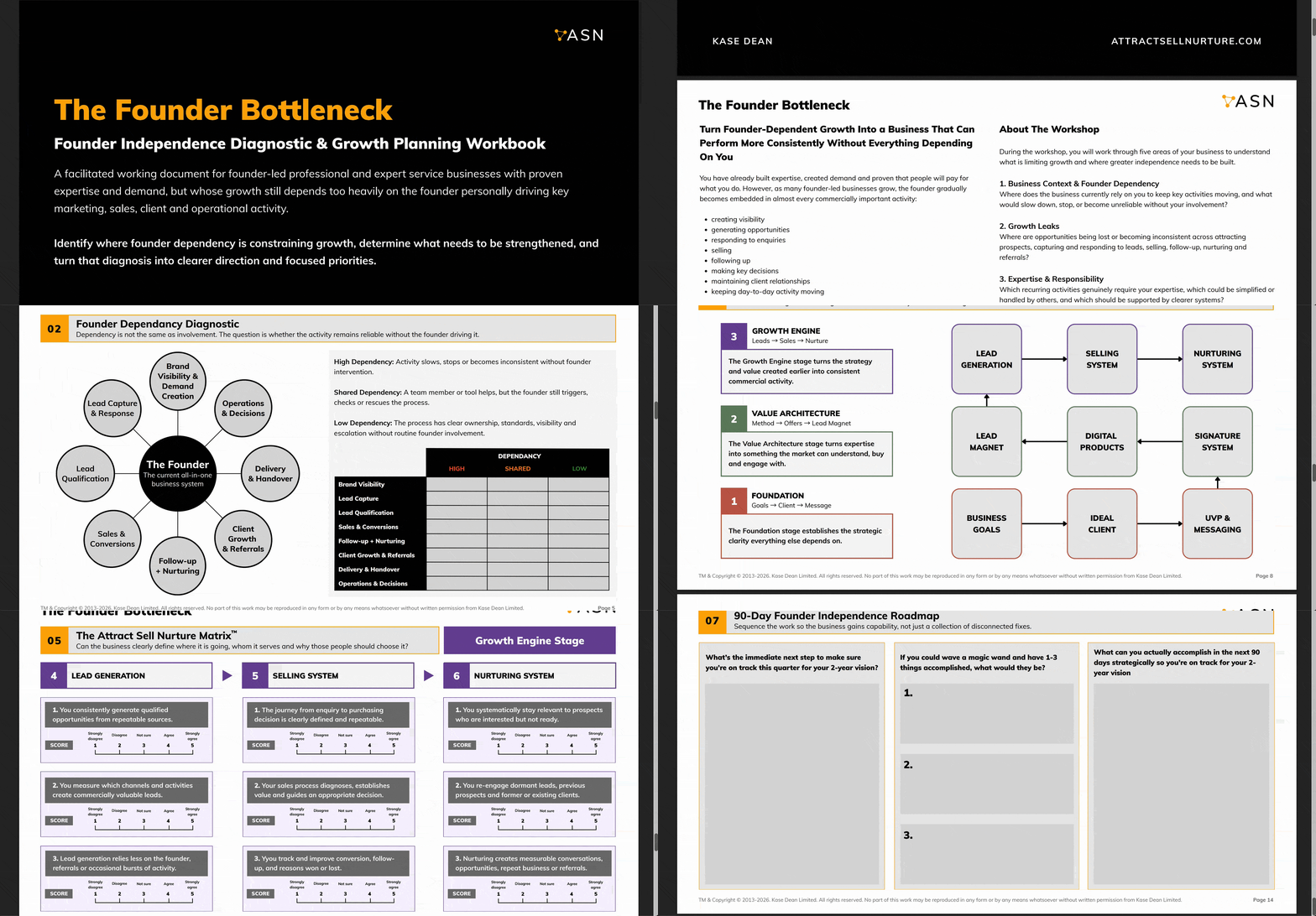
Before installing the Attract Sell Nurture™ Framework, you need to assess honestly where your service business growth systems stand today. Most UK professional services firms fall into one of three categories:
- The Referrals-Only Practice: High reputation, zero systems. Revenue is entirely dependent on external factors and founder networking.
- The Fragmented Firm: Has a CRM and some automation, but no connected lead pipeline. Data is siloed, and follow-up is manual and inconsistent.
- The Scalable Engine: Full implementation of the nine milestones. Marketing, sales and lead nurture automation run independently of the founder.
Goal: Identify which phase (Attract, Sell or Nurture) has the most significant revenue leak before you start implementing.
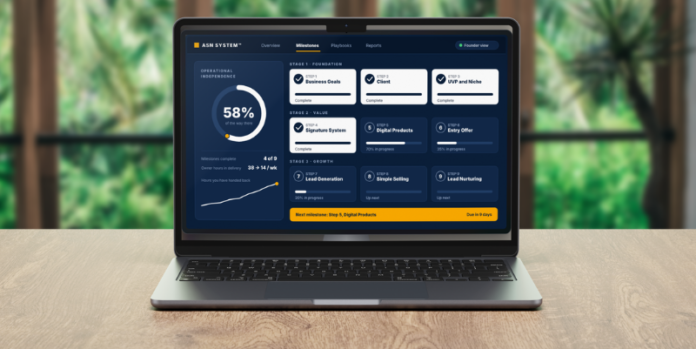
The Nine Milestones of The ASN System™: A Roadmap to Independence
In my experience working with UK service founders, moving from founder-led chaos to a repeatable lead pipeline means adopting the Attract Sell Nurture™ Framework across nine specific milestones.
The framework installs repeatable marketing, sales and nurture sequences across three critical phases.
Phase 1: Attract (The Magnetism Milestones)
- Strategic Goals: Align your business objectives with personal aspirations. I’ve observed that when growth aligns with life goals, it becomes more sustainable and fulfilling.
- Ideal Client Profiling: Go beyond basic demographics. Identify the specific trigger events that prompt potential clients to seek your expertise, as I’ve done for a London boutique consultancy.
- Magnetic Messaging: Develop a compelling narrative that draws in ideal clients and filters out mismatches. This approach helped a Midlands-based professional services firm refine its client base.
Phase 2: Sell (The Conversion Milestones)
- Signature System: Document your unique delivery process into a named, visual framework. This builds confidence in prospects and differentiates your service in a crowded market.
- The Irresistible Offer: Create a value-driven proposal where the price becomes secondary. This strategy has been a game-changer for many of the UK consultancies I’ve worked with.
- Lead Magnet & Funnel: Develop a “hand-raiser” asset to capture contact details from potential clients who are not yet ready for a full consultation.
Phase 3: Nurture (The Continuity Milestones)
- Sales Process Systemisation: Standardise your response, qualification and follow-up processes so they stay consistent regardless of who is at the helm.
- Automated Lead Nurture: Deploy lead nurture automation to maintain a “stay in touch” sequence that provides ongoing value, keeping your lead pipeline active until prospects are ready to commit.
- Database Reactivation: Regularly re-engage existing contacts to uncover hidden revenue from past quotes and inactive clients.
Without all nine milestones, the system is incomplete. A firm with excellent messaging but no lead magnet cannot capture interest effectively, while a firm with a robust funnel but no sales process will see leads slip through the cracks.
Key Takeaways: Stabilising Your Growth Engine
- Move Beyond Referrals: Relying solely on word-of-mouth leads to inconsistent lead flow. A predictable lead pipeline needs a system that operates independently of your constant presence.
- The ASN System™ Framework: Achieve sustainable growth by integrating the pillars of Attract, Sell and Nurture, using lead nurture automation to maintain visibility.
- Strategy Before Technology: No software can rectify a flawed process. Prioritise empathy and strategy before automating with technology.
- Focus on Continuity: Inconsistent lead flow is often a continuity issue, not a volume one. Reactivating your existing database can quickly stabilise revenue.
An inconsistent lead flow isn’t a volume issue; it’s a continuity problem. Adding more leads to a broken process merely increases the number of neglected opportunities.
The Attract Sell Nurture™ Framework lets you treat growth as a defined process that continues seamlessly regardless of the founder’s availability.
Core Concepts: Understanding Service Business Growth Systems Terminology
Before diagnosing what is broken, it helps to agree on what the parts are called.
These terms get used loosely in UK professional services marketing, and the looseness is part of why firms buy tools that solve the wrong problem.
Lead pipeline
The defined journey a person travels from first hearing your name to signing an engagement letter, broken into stages you can count, time and improve.
Lead
Someone who has permitted you to contact them, which is a far lower bar than someone ready to buy. The gap between those two states is where most revenue is lost.
Database reactivation
A structured campaign that re-opens conversations with contacts already in your records (old enquiries, lapsed clients, event lists) using genuinely useful messages rather than a generic “just checking in”.
Lead nurture
The planned sequence of contact that builds trust and credibility with people who are not ready yet, so that you are the obvious call when their situation changes.
Systemisation
Replacing tasks that depend on someone remembering with repeatable workflows that run to a defined standard every time, whether they are triggered by a person or by software.
Conversion rate
The percentage of people who move from one defined pipeline stage to the next, measured per stage rather than as a single number, because an overall rate hides where the leak actually is.
Speed to lead
The elapsed time between an enquiry arriving and a human or system making meaningful contact, usually the single most controllable variable in the whole pipeline.
These seven concepts form the shared vocabulary for everything that follows.
The Cost of Fragmentation: Why Your Leads Aren’t Converting
Most stalled pipelines are not empty. They are full of people who were contacted once, filed nowhere and forgotten.
Fragmentation is the cost of running attraction, selling and follow-up as three separate habits rather than one connected process.
In UK professional services marketing, this lack of cohesion is the single biggest barrier to a predictable lead pipeline and often results in inconsistent lead flow.
The Follow-up Gap
An enquiry arrives at 4 pm on a Thursday while you are in client work. You reply on Monday.
By then they have spoken to two other firms and formed an opinion. Multiply that by a year, and you have a pile of neglected leads: interested people, received one email and never heard from you again.
Nobody decided to abandon them. There was simply no system holding them.
The Process Gap
Ask three people in the same firm what happens after a discovery call, and you will often get three answers. Without a defined next step at every interaction, prospects are left to chase you, and interested buyers who have to chase usually do not. Standard stages, standard timings and standard documents remove the need for anyone to improvise under pressure.
The Data Gap
When marketing cannot see which enquiries became clients, it keeps optimising for volume. When the person selling cannot see what the prospect already read or downloaded, every call starts from zero. The two halves of the business are working from different versions of the truth.
That disconnect is expensive. Forrester research is widely cited as showing that organisations with tightly aligned sales and marketing grow revenue significantly faster than those without.
Alignment here does not mean a bigger department. In a ten-person consultancy it means one shared record of every contact, one agreed definition of a qualified enquiry, and one place where the next action is visible.
Attract: Moving from Chasing to Magnetising
Attraction fails when it is aimed at everyone. A firm that describes itself as “a full-service practice supporting businesses of all sizes” gives a prospect nothing to recognise themselves in, so the only people who enquire are those already told to by a mutual contact. The fix starts with an ideal client profile that is specific enough to be exclusionary: sector, size, situation, and the trigger event that makes them start looking. Turnover bands alone are not a profile. “Owner-managed engineering firms approaching a sale within 24 months” is.
With that clarity, messaging changes shape. Features describe what you do. Pain describes what they are living with at 11 pm on a Sunday. A tax practice listing its services sounds like every other tax practice. The same practice describing the moment a client realises their current structure will cost them six figures on exit is speaking to a feeling the reader already has. Write about their situation first and your credentials second.
Early-stage attraction also needs a way for interested people to raise their hand before they are ready to talk. A useful diagnostic, a template or a short guide to the decision they are facing converts anonymous attention into a named contact you can keep helping.
Within the Attract Sell Nurture™ Framework, this is what keeps your lead pipeline fed with qualified prospects and breaks the “feast or famine” cycle so common in UK professional services marketing. It is the point where attraction stops being broadcast and starts filling a measurable pipeline.
A Signature System is your method, named and mapped. Instead of selling “consultancy”, you sell a defined sequence of stages with named outputs, so the buyer can see exactly what happens, in what order, and what they get. It converts expertise that lives in your head into something a prospect can evaluate, compare and say yes to.
Sell: Turning Enquiries into Predictable Revenue
Selling in a professional firm rarely fails on charisma. It fails on friction and memory: the enquiry that waited, the proposal that took nine days, the prospect who went silent and was never followed up.
Removing those gaps is a core requirement of service business growth systems. It is a design job, not a motivation job, and it starts by agreeing what the milestones are.
- Response. Every enquiry receives an acknowledgement and a booking link within minutes, not hours, regardless of who is free.
- Qualification. A short set of questions, asked the same way every time, establishes fit, timing and budget before anyone gives up an hour of billable capacity.
- Consultation. A structured conversation with a defined agenda, held by the person best placed to diagnose the problem rather than whoever answered the phone.
- Decision. A proposal issued within an agreed window, followed by a scheduled review call, with the next step confirmed in writing at the end of every interaction.
Automation belongs at the two ends. Scheduling, reminders, qualification questions, document collection and follow-up sequences run perfectly well without you, and run better than a busy founder does.
What automation must never touch is the moment of truth: the conversation where someone with real expertise listens to a specific situation and tells the truth about whether they can help. In high-value services, that conversation is the product demonstration.
The discipline that holds it all together is simple and widely ignored. No interaction ends without a named next step and a date. “I’ll send some thoughts over” is not a next step. “I’ll send the scope on Tuesday, and we’ll review it at 10 am Thursday” is a pipeline stage with a deadline attached.
Nurture: How Lead Nurture Automation Creates Long-Term Pipeline Stability
Most firms lose more money after the first conversation than before it. Buyers in legal, financial and advisory services move on their own timetable, often a year or more from first contact, and the firm that stays present without pestering wins by default.
This is where The Attract Sell Nurture™ Framework earns its keep: consistent lead nurture automation replaces an inconsistent lead flow with steady, predictable contact.
Follow-up
A single unanswered email is not a no; it is a Tuesday when someone was busy. A defined sequence of varied, genuinely useful contact over weeks and months keeps you present through the period when the prospect is thinking, and it runs whether or not you remember to send it.
Reactivation
Your existing database is the cheapest pipeline you will ever own: old enquiries, quoted-but-not-won, lapsed clients, people who met you at an event three years ago. A structured reactivation campaign re-opens those conversations with something worth reading, and it regularly surfaces work that was sitting in a spreadsheet nobody had opened since 2023.
Social Proof
Reviews and testimonials get requested when someone remembers, which means they get requested rarely and at the wrong moment. Systemising the ask, at a defined point after a defined milestone, turns proof into a steady output rather than an annual scramble before a pitch.
The balance matters more than the mechanism. Lead nurture automation should carry the repetition, the timing and the reminders, while the content it carries sounds like a person who understands the reader’s situation. The moment a sequence reads like software, it stops nurturing and starts eroding the trust you built in the first conversation.
Empathy, Strategy, Technology: The Implementation Order
The order is not decorative. Reversing it is the most common and most expensive mistake in service business growth systems, because software makes a bad process faster rather than better.
- Empathy first. Before any tool is chosen, map what the client actually experiences: what triggered the search, what they typed into Google at midnight, what they fear getting wrong, who else has to approve the decision, and what a reassuring response looks like to them. This is unglamorous work and usually involves reading your own enquiry emails properly for the first time in years. Everything downstream is built from what you find here.
- Strategy second. With the journey mapped, decide what happens at each stage: who is responsible, what gets sent, how quickly, what qualifies someone to move forward, and what happens when they go quiet. Write it down as a process a new starter could follow. If the sequence only works when the founder is available, it is not a strategy; it is a rota with one name on it.
- Technology third. Only now do you choose tools, and you choose them to execute decisions you have already made. A CRM should hold the pipeline stages you defined. An automation platform should send the sequences you wrote. AI should handle the triage and follow-up you specified. Selection becomes straightforward because you know precisely what the tool has to do.
Firms that start at step three end up with four subscriptions, two partial databases and no improvement, then conclude that lead nurture automation does not work for their sector.
In reality, they skipped the strategic mapping that service business growth systems depend on. The software was never the problem. It was asked to invent a process rather than run one.
AI and Lead Nurture Automation in UK Professional Services Marketing
AI is most useful in a professional firm where it does the work nobody has time to do consistently, and least useful where judgement, confidentiality and credibility are at stake. The split is reasonably clean.
| Task | AI role | Human role |
|---|---|---|
| Enquiry response | Replies within minutes, acknowledges the specific request, offers available times | Sets the tone, approves the wording, handles anything unusual |
| Qualification | Asks the agreed questions, captures answers, flags fit and urgency | Reviews flagged cases, overrules the score when context demands it |
| Database reactivation | Runs the sequence, personalises by segment, handles replies until a booking | Writes the angle, decides who gets contacted, takes over live conversations |
| Follow-up after a proposal | Chases on schedule, varies the message, never forgets | Makes the judgement call on when to stop, picks up the phone |
| Diagnosis and advice | None | Everything |
| Review requests | Triggers the ask at the right milestone, nudges once | Responds personally to what clients say |
| Reporting | Compiles stage conversion and speed-to-lead figures | Decides what the numbers mean and what changes |
The practical stack for a UK firm is smaller than vendors suggest: one CRM holding every contact and pipeline stage, one layer handling automated follow-up and reactivation, and one process for collecting reviews. ASN Activate is built for that middle layer, working the leads and dormant contacts you already have.
Where AI fails is the part clients are buying. Nobody instructs a solicitor or appoints an adviser because a chatbot was articulate. They instruct because an expert understood their position. Use the technology to make sure that expert conversation happens sooner and more often.
Scaling Beyond the Founder: The 90-Day Growth Roadmap
Moving from being the engine of your business to being its engineer requires a phased approach to service business growth systems.
This roadmap tackles inconsistent lead flow by installing the Attract Sell Nurture™ Framework across your lead pipeline.
- Days 1-30: Foundation & Reactivation. Map the client journey (Empathy) and run a reactivation campaign on your existing database. This can generate early cash flow to help fund further systems.
- Days 31-60: The Sales Process. Systemise qualification and follow-up. Install lead nurture automation to catch the “not ready yet” enquiries.
- Days 61-90: Magnetising Attraction. Refine messaging and launch high-value lead magnets to feed the system consistently.
By the end of 90 days, the founder should be removed from at least 70% of the administrative growth tasks, freeing them for strategic leadership and higher-value client delivery.
Common Pitfalls in Implementing Service Business Growth Systems
Most implementations fail for the same four reasons, and all of them are avoidable before a penny is spent.
- Mistake: Buying a six-tool stack in month one because a competitor mentioned theirs.
- Fix: Start with one CRM, one defined pipeline and one automated follow-up sequence. Run it for ninety days. Add a tool only when a specific, named bottleneck justifies it, and only when someone owns the admin for it.
- Mistake: Pouring budget into attraction while ignoring nurture, then concluding that the ads did not work.
- Fix: Fix follow-up before increasing volume. If the firm cannot reliably work the enquiries it already receives, more enquiries simply enlarge the pile. Reactivating your existing database usually produces meetings faster and more cheaply than any new campaign.
- Mistake: Measuring enquiry count and nothing else, so the loudest channel looks like the best one.
- Fix: Define what a good lead looks like in writing, then track stage-by-stage conversion and the source of actual clients, not actual enquiries. A channel producing twelve enquiries and no instructions is a cost, however impressive the dashboard.
- Mistake: Accepting a plan written in jargon because it sounds like expertise.
- Fix: Insist that every deliverable is described as a business outcome with a number attached: response time, meetings booked, proposals issued, clients won. If a supplier cannot explain the mechanism in plain English, the mechanism is usually either trivial or absent.
The pattern underneath all four is the same: complexity gets added before the simple version has been made to work, and the firm ends up maintaining a system it never managed to run.
Without a clear Attract Sell Nurture™ Framework, the result is the same inconsistent lead flow, only with more tools to pay for.
Related Resources for Further Growth
Each pillar in this guide has depth behind it.
These are the places to go when you are ready to build a specific part rather than understand the whole.
- How to build a lead magnet that actually converts. Covers the difference between a download nobody opens and a diagnostic that produces booked meetings, including how to choose the one problem your ideal client would pay to have solved today, and how to handle the enquiries it generates in the first 48 hours.
- Database reactivation scripts for professional services. Message-by-message sequences for lapsed clients, old quotes and dormant enquiry lists, with the compliance considerations UK legal and financial firms need to account for before pressing send, plus guidance on segmenting a list so the opening line lands as relevant rather than generic.
- ASN Activate: AI-powered follow-up and reactivation. Go here to see how the nurture layer works in practice, how fast enquiries get answered, how dormant contacts are re-engaged, and where a human takes over the conversation. Useful if you have already decided follow-up is your bottleneck.
- Scaling a UK consultancy from 5 to 20 staff. A worked example of what changes structurally when growth stops depending on one person’s diary, including how the pipeline stages, the qualification criteria and the delivery team had to be redesigned together rather than in sequence.
- The 9-Step ASN System checklist. A one-page audit of the nine milestones across Attract, Sell and Nurture, scored against what is really happening in your business, so you can see which two or three are costing you the most revenue right now rather than attempting all nine at once.
Start with whichever stage is leaking. The checklist will tell you which one that is.
The Bottom Line: Stabilising Your Lead Pipeline with the Attract Sell Nurture Framework
- Feast or famine is a systems failure, not an effort failure. Stabilising your lead pipeline means moving from manual chasing to connected service business growth systems and dependable lead nurture automation. If growth only happens in the weeks you have spare capacity, marketing and selling are still tasks rather than processes. Adding more leads to an unstructured pipeline increases waste, not revenue.
- Alignment between attracting, selling and nurturing is what makes a pipeline predictable. When the same record shows where every contact came from, what they have received and what happens next, nobody improvises, and nobody is forgotten. Firms that connect these three stages grow faster than firms that run them as separate habits.
- Empathy comes before strategy, and strategy comes before technology. Understand the client’s actual journey, design the process around it, then choose tools to execute it. Most expensive implementation failures in professional services start by reversing that order.
- Automation should carry the repetition so you can carry the relationship. Reminders, scheduling, qualification questions and follow-up sequences do not need your judgement. Diagnosis, advice and the conversation where someone decides to trust you absolutely do.
- Your existing database is usually the fastest route to stability. Before increasing spend on attraction, work the enquiries, lapsed clients and old quotes already sitting in your records. That pipeline is already paid for.
- Measure stages, not totals. Track speed to lead, the proportion of enquiries that reach a consultation, and the source of clients won rather than enquiries received. A single overall conversion rate hides the exact point where the money is leaking.
The test of a working system is simple. If you took three weeks off, would enquiries still arrive, get answered, get qualified and get followed up?
If the answer is no, you have found your next project.
Next Steps: Installing the ASN System™ in Your Business
If any of this has felt uncomfortably familiar, the discomfort is worth something. Most founders in UK legal, financial and consultancy practices reach this point having done everything right on delivery and still finding the diary unpredictable. That is not a reflection of your expertise.
It is the arithmetic of a business where growth runs on personal availability, and nothing catches what falls through.
The ASN System™ exists to change that arithmetic, providing a robust lead pipeline through nine milestones across three stages:
- Attract, so the right people recognise themselves in what you say and raise their hand;
- Sell, so every enquiry meets the same defined process regardless of who is busy;
- Nurture, so the people who are not ready yet still hear from you when their situation changes.
Installed properly, it means the pipeline keeps moving through your busiest delivery weeks, through holidays, and through the months you historically went quiet.
Growth stops being something you do when you have time and becomes something the business does continuously.
The sensible first move is a clear look at what you already have: where enquiries come from now, how quickly they are answered, how many contacts are sitting dormant in your records, and which of the nine milestones are missing. Most firms discover two or three specific gaps rather than a wholesale rebuild, and fixing those usually produces booked meetings within weeks rather than quarters.
Book a discovery call and bring whatever you have, even if it is a spreadsheet and an inbox. The conversation is a diagnosis, not a pitch. You already know how to do the work brilliantly. What is missing is the system that keeps the right people walking through the door while you do it.