


TL;DR: Writing business processes isn’t the same as transferring judgement. Until your standards and reasoning are documented, your business still depends on you personally, no matter how many checklists exist.
- Systemisation transfers judgement, not just tasks.
- Define the outcome first, then document the reasoning behind it.
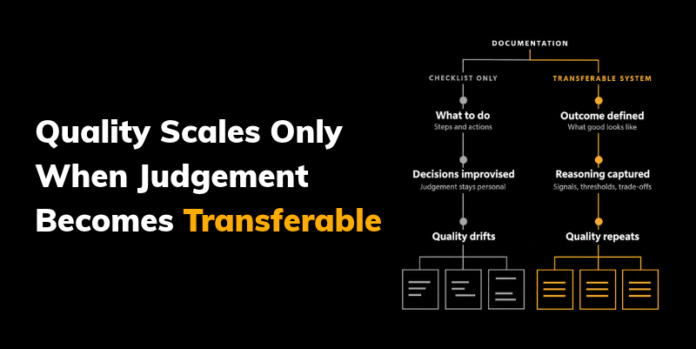
- A checklist tells people what to do. Your standards tell them what good looks like.
- The reasoning behind a result is the real unit of transfer.
- Once outcomes are teachable, they become replicable without you in the room.
I know a founder who spent six months writing processes.
Checklists for onboarding. Documents for delivery. Step-by-step guides for almost everything.
Then he took a week off… and the quality dropped anyway.
The steps were followed. The boxes were ticked. The work still came back wrong, because the thing that made his work good had never been written down. It was still sitting in his head, doing what it always had, which was working fine right up until he wasn’t there.
I’ve lived a version of the same thing myself. You build the documentation, feel like you’ve handled it, and then something slips and you realise the documentation was never really the point. What I’m beginning to notice in capable, established owners is that the paperwork exists and the dependency stays exactly where it was.
What Actually Gets Transferred
Systemisation is the transfer of judgement. The processes and checklists are packaging around it, useful packaging, but packaging.
When you deliver work at a standard your clients trust, you’re making dozens of small decisions along the way. When to push back. When something is good enough. When a detail matters more than the deadline. What “done properly” looks like in this specific situation.
That is the asset. That’s what your business actually runs on.
A checklist tells someone what to do. Your judgement tells them what a good result looks like, and why. When you only transfer the first part, people follow the steps and still miss the outcome. When you transfer the second part, people you’ve never sat next to can reach the same standard you’d reach yourself.
Key Point: The real unit of systemisation isn’t the task, it’s the reasoning behind the result.
How to Define the Outcome First
The practical move is simpler than it sounds, though that doesn’t mean it’s fast.
Define the outcome first. Write down, in plain terms, what a great result looks like for each piece of work your business produces. The standard the client feels. The quality markers you check without thinking.
Then capture the reasoning. For each decision point, record how you’d think it through. The questions you’d ask. The signals that tell you something’s off. The threshold where “fine” becomes “fix it”.
Once the outcome and the reasoning are documented, the outcome becomes teachable. And once it’s teachable, it becomes replicable… by your team, at scale, without you in the room.
In construction terms, most owners hand over the floor plan and keep the architectural vision to themselves. The vision is the load-bearing part. That’s the piece your people need if you want the build to hold.
Key Point: Defining the outcome before the process gives your team something to aim at, not just something to follow.
Why This Gets Overlooked
Systemisation gets treated as a bureaucratic chore, something you do to tidy the business up. So it gets pushed down the list, behind sales, behind delivery, behind everything urgent.
Writing down your own thinking feels slow, and slightly uncomfortable, because it forces you to admit how much of the business depends on you personally.
That discomfort is worth sitting in for a while.
Every hour of judgement you make transferable buys back your own capacity. It also protects your clients, your team, and your family from the fragility of a business that stalls whenever you step away. The ripple effect of that one structural change reaches further than it first appears.
There’s a commercial layer too. A business whose quality depends on transferable standards holds its value. Buyers, successors, and senior hires can all pick it up and carry it. A business whose quality lives in one person’s instincts carries a quiet ceiling on everything: growth, valuation, and the owner’s freedom.
Key Point: The discomfort of documenting your own judgement is a signal that you’re working on the right thing.
Where to Begin This Week
You don’t need a six-month documentation project. Start small and compound it.
Pick one piece of work you’d normally review personally. Write down the three things you always check before you’d call it excellent. Then explain, in a paragraph each, why those things matter and how you judge them.
Hand that to someone on your team. Let them deliver against it. Refine the document where their result drifted from yours.
Repeat weekly. Within a few months, you’ve built a growing library of your own standards… a set of assets your business owns, rather than borrows from you every day.
Key Point: One documented standard, refined weekly, compounds into something your business can own permanently.
The Recap
Systemisation works when it transfers your knowledge, your standards, and your judgement. Outcomes, once clearly defined, can be documented, taught, and replicated by people you may never meet. The reasoning behind a result is the real unit of transfer, and capturing it is what frees you to hold the direction while others hold the delivery.
Making your judgement transferable is how your business starts to grow without leaning on you for everything.
Frequently Asked Questions
What is systemisation in a small business?
Systemisation is the process of making your knowledge, standards, and judgement transferable to other people, so work reaches a consistent standard whether you’re involved or not.
Why do checklists and processes fail to maintain quality?
Checklists capture what to do, not how to think. When the reasoning behind a result isn’t documented, people follow steps but miss the outcome, because judgement hasn’t been transferred.
What should I document first when systemising my business?
Start with the outcome. Define what a great result looks like for one specific piece of work, then document the reasoning you use to reach it.
How do I transfer my judgement to my team?
For each decision point in your work, write down the questions you ask, the signals you look for, and the threshold where something needs fixing. That reasoning, not the task list, is what your team needs.
How long does it take to systemise properly?
It doesn’t need to be a six-month project. One standard documented per week compounds significantly over a few months into a library of transferable quality your business owns.
What happens to a business that doesn’t systemise its judgement?
It carries a ceiling. Growth, valuation, and the owner’s freedom are all constrained when quality depends on one person’s presence rather than a set of transferable standards.
Does systemisation reduce the founder’s value to the business?
Structurally, it increases it. When your judgement is transferable, you shift from being the delivery mechanism to being the architect of quality. Your thinking scales without requiring your time.
Key Takeaways
- Systemisation transfers judgement, not just tasks. Checklists are packaging, not the asset.
- The reasoning behind a result is what your team actually needs to replicate your standard.
- Define the outcome before the process, then document how you think through each decision.
- The discomfort of documenting your own thinking is a sign you’re working on something structurally important.
- A business whose quality lives in transferable standards holds its value. One that depends on one person’s instincts carries a quiet ceiling.
- Start with one piece of work, one set of standards, refined weekly. Compound it from there.
- Making your judgement transferable is what shifts you from being the bottleneck to being the architect.